Bill's Recipes
Cabbage Kimchi (2 qt. version)
(Baechu, or napa cabbage, kimchi)Makes about 2 quarts
Baechu, or napa cabbage, kimchi is made by lacto-fermentation, the
same process that creates sauerkraut and traditional dill pickles. In
the first stage, the cabbage is soaked in a salty brine that kills off
harmful bacteria. In the second stage, the remaining Lactobacillus
bacteria (the good guys!) convert sugars into lactic acid, which
preserves the vegetables and gives them that wonderful, tangy flavor.
2 one quart jars, Mason jars preferred
1-2 medium head (3 pounds total) napa cabbage
1/3 cup sea salt or kosher salt (see notes)
distilled or filtered water (see notes)
1 tablespoons grated garlic (about 3 cloves)
1 teaspoons grated ginger
1 teaspoons sugar
3 tablespoons Korean fish sauce or water (optional, see
notes)
1 to 6 tablespoons Korean red pepper flakes (gochugaru),
use 3 tablespoons for medium.
2/3 pounds Korean radish or daikon, peeled and cut into matchsticks
5 scallions, about 1 bunches, trimmed and cut into 1-inch pieces
1/3 lb carrots, cut into matchsticks (Optional)
1. Rincs the cabbage then slice it: Cut the cabbage lengthwise into quarters and remove the cores. Cut each quarter crosswise into 1-2-inch-wide strips.
To split a cabbage in quarters without shredding the densely packed leaves inside, first cut two short slits in the base of the cabbage, and then gently pull the quarters apart so the cabbage splits open.
2. Salt the cabbage: Place the cabbage and salt in a large container. Put a layer of cabbage in the bowl, sprinkle some salt on top, repeat. Put a plate on top and weigh it down with something heavy, like a jar or can of beans. Then add distilled water to cover the cabbage. Let stand for 1 to 2 hours.
3. Make the paste: Combine the garlic, ginger, sugar, gochugaru and fish sauce (or water) in a small bowl and mix to form a smooth paste.
4. Rinse and drain the cabbage: Rinse the cabbage under cold water thoroughly and drain.
5. Combine the vegetables and paste: Gently squeeze any remaining water from the cabbage and place in a large bowl along with the radish, scallions, carrots and seasoning paste.
6. Mix thoroughly: Using your hands or a wooden spoon, gently work the paste into the vegetables until they are thoroughly coated.

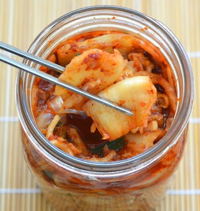
7. Packing: Pack the kimchi into the jars, pressing down on it until the brine rises to cover the vegetables. Leave at least 1 inch of headspace. Use a tamper or a wooden spoon to press the ingredients down and release any trapped air. Put the tops on the jars (not the screw portion) together with small weights to keep the lids in place. The eidea is to form a valve that allows excess gas to escape while preventing dust and other such from entering.
8. Let it ferment: Let the jars stand at room temperature for 3 to 7 days. You will see bubbles inside the jars and brine may seep out of the lid; place a bowl or plate under the jars to help catch any overflow. You will see bubbles only when tamping. At warmer temps, less time and you may see lots of bubbles.
9. Check the kimchi once or twice a
day, pressing down on the vegetables with a tamper or wooden spoon to
keep them submerged under the brine. (This also releases gases
produced during fermentation.) Taste a little at this point, too! When
the kimchi tastes ripe enough for your liking, transfer the jar to the
refrigerator. You may eat it right away, but it's best after another
week or two.
Recipe Notes
Salt: Use salt that is free of iodine and anti-caking agents, which can inhibit fermentation.
Water: Chlorinated water can inhibit fermentation, so use spring, distilled, or filtered water.
Seafood flavor and vegetarian alternatives: Seafood gives kimchi an umami flavor. Different regions and families may use fish sauce, salted shrimp paste, oysters, and other seafood. Use about 3 tablespoons of fish sauce (I use Thai Kitchen brand), salted shrimp paste, or a combination of the two. For vegetarian kimchi, you can use 1 teaspoon kelp powder mixed with 3 tablespoons water, or simply 3 tablespoons of water. Another alternative is 3 tablespoons of white or red miso paste.