Bill's Recipes
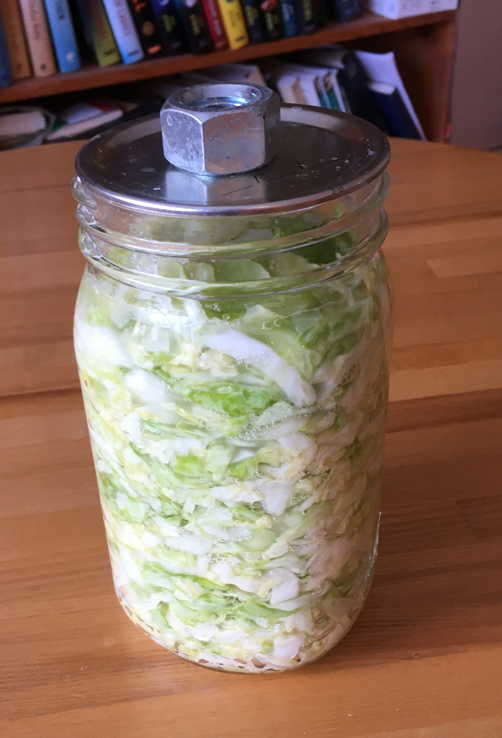
Home Made Sauerkraut
Ingredients
1 small head green cabbage (about 2 pounds)
makes about 1 quart
1 tablespoon kosher salt
extra liquid:
1 teaspoon of salt in 1 cup of water
1 - 1 qt wide mouth mason jar
Discard the wilted, limp outer leaves of the cabbage. Cut the cabbage into quarters and trim out the core. Slice each quarter down its length, making 8 wedges. Slice each wedge crosswise into very thin ribbons.
Transfer the cabbage to a big bowl and sprinkle the salt over top. Begin working the salt into the cabbage by massaging and squeezing the cabbage with your hands. At first it might not seem like enough salt, but gradually the cabbage will become watery and limp — more like coleslaw than raw cabbage. This will take 5 to 10 minutes.
Pack the cabbage into the jar. Every so often, tamp down the cabbage in the jar with a tamper. Pour any liquid released by the cabbage while you were massaging it into the jar.
Put a canning lid on top (only the part with the seal, not the threaded part). Put a small weight on top. This acts like a valve to allow any gas generated to escape without allowing any outside air in.
Add extra liquid, if needed. If after 24 hours, the liquid has not risen above the cabbage, dissolve 1 teaspoon of salt in 1 cup of water and add enough to submerge the cabbage.
Ferment the cabbage for 3 to 10 days. As it's fermenting, keep the
sauerkraut away from direct sunlight and at a cool room temperature —
ideally 65°F to 75°F. Check it daily and press it down if the cabbage
is floating above the liquid.

Store sauerkraut for several months in a refrigerator. This sauerkraut is a fermented product so it will keep for at least two months and often longer if kept refrigerated. As long as it still tastes and smells good to eat, it will be. If you like, you can transfer the sauerkraut to a smaller container for longer storage.
Recipe Notes:
Sauerkraut with other cabbages: Red cabbage, napa cabbage, and other cabbages all make great sauerkraut. Make individual batches or mix them up for a multi-colored sauerkraut!
Canning sauerkraut: You can process sauerkraut for longer storage outside of refrigeration, but the canning process will kill the good bacterias produced by the fermentation process.
Larger or smaller batches: To make larger or smaller batches of sauerkraut, keep the same ratio of cabbage to salt and adjust the size of the container. Smaller batches will ferment more quickly and larger batches will take longer.
Hot and cold temperatures: Do everything you can to store sauerkraut at a cool room temperature. At high temperatures, the sauerkraut can sometimes become unappetizingly mushy or go bad. Low temperatures (above freezing) are fine, but fermentation will proceed more slowly.
Sauerkraut is often one of the first fermentation projects recommended to curious DIY-ers, and with good reason: It’s beyond easy to make, it requires very little special equipment, and the results are dependably delicious. All you need to do is combine shredded cabbage with some salt and pack it into a container — a crock if you have one and want to make a lot of sauerkraut, but a mason jar will do just fine for small batches.
The cabbage releases liquid, creating its own brining solution. Submerged in this liquid for a period of several days or weeks, the cabbage slowly ferments into the crunchy, sour condiment we know and love as sauerkraut.
How Long Does It Take to Make Sauerkraut?
For a small quart-sized batch like we’re making today, the minimum time is about three days, although the kraut will continue to ferment and become tastier for many days after that. As simple as it sounds, the best rule of thumb is to keep tasting the kraut and refrigerate (or take it cellar temperature) when it tastes good to you. The sauerkraut is safe to eat at every stage of the process, so there is no real minimum or maximum fermentation time.
What Can Go Wrong?
Not much! You may see bubbles, foam, or white scum on the surface of the sauerkraut, but these are all signs of normal, healthy fermentation. The white scum can be skimmed off as you see it or before refrigerating the sauerkraut.
If you get a very active fermentation or if your mason jar is very full, the brine can sometimes bubble up over the top of the jar. This is part of the reason why I recommend using a larger mason jar than is really necessary to hold the cabbage. If you do get a bubble-up, it’s nothing to worry about — just place a plate below the jar to catch the drips and make sure the cabbage continues to be covered by the brine.
It is possible you might find mold growing on the surface of the sauerkraut, but don’t panic! Mold typically forms only when the cabbage isn’t fully submerged or if it’s too hot in your kitchen. The sauerkraut is still fine (it’s still preserved by the lactic acid) — you can scoop off the mold and proceed with fermentation. This said, it’s still important to use your best judgement when fermenting. If something smells or tastes moldy or unappetizing, trust your senses and toss the batch.